


Most companies don’t struggle with ideas.
They struggle with execution.
You’ve probably seen it. Plans get approved. Tools get purchased. But somewhere between planning and doing, things slow down.
That’s exactly where agentic AI comes in.
But here’s the catch. Just deciding to use it isn’t enough. The way you implement it determines whether it actually helps or just becomes another unused system.
So let’s walk through how to approach this in a way that works.
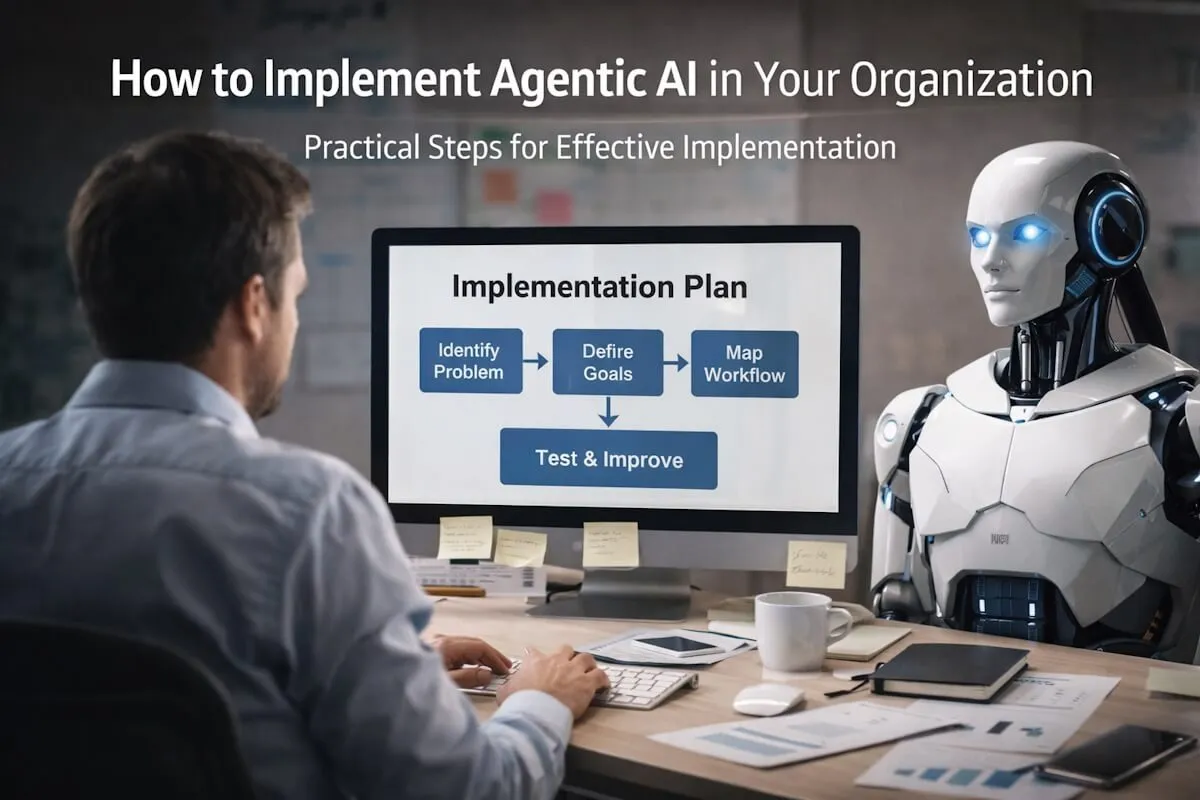
Start with one real problem
Before anything else, focus on a specific issue.
Not a broad goal like “improve productivity.”
Instead, look for:
- Tasks that repeat every day
- Processes that require constant follow-up
- Areas where delays happen often
For example:
- Lead follow-ups not happening on time
- Customer support tickets piling up
- Internal tasks getting stuck between teams
Pick one.
That becomes your starting point.
Define what success looks like
You need a clear outcome.
Not just what the system should do, but what it should achieve.
For example:
- Reduce response time from hours to minutes
- Ensure every lead gets a follow-up within a set time
- Improve task completion rates
This clarity helps you design better systems.
Without it, execution becomes scattered.
Map your current workflow
Before changing anything, understand what’s already happening.
Break down:
- Each step in the process
- Who is involved
- Where decisions are made
- Where delays occur
This gives you a realistic picture.
Most workflows are more complex than they appear.
Skipping this step leads to poor system design.
Identify decision points
Agentic AI is not just about actions.
It’s about decisions.
You need to define:
- When the system should act
- What action it should take
- When it should stop
- When it should escalate
For example:
- If a lead responds, move to the next step
- If there’s no response after three attempts, stop
- If a request is complex, escalate to a human
These rules guide the system.
Keep the first implementation small
Don’t try to automate everything.
Start with one workflow.
Get it working properly.
Then expand.
This approach:
- Reduces risk
- Makes testing easier
- Gives faster results
Trying to do too much at once often leads to confusion.
Connect the right tools
Your system needs access to data and actions.
That means connecting it to your existing tools.
Such as:
- CRM systems
- Email platforms
- Support tools
- Internal databases
Keep it simple at first.
Only connect what’s necessary.
Too many integrations early on can make things harder to manage.
Build clear boundaries
Your system should not act without limits.
Define:
- What it can do on its own
- What requires approval
- When to escalate
This creates control.
And it makes your team more comfortable using the system.
Test with real scenarios
Don’t rely on perfect examples.
Test with real data and situations.
Look for:
- Missing information
- Unexpected inputs
- System failures
This helps you catch issues early.
And it improves reliability.
Keep humans involved at the start
You don’t need full automation immediately.
In the beginning:
- Review actions
- Monitor outputs
- Step in when needed
This builds trust.
Over time, as the system improves, you can reduce manual oversight.
Improve continuously
Your first version won’t be perfect.
That’s normal.
You’ll need to:
- Monitor performance
- Identify weak points
- Adjust workflows
Agentic systems improve over time.
Treat them as ongoing projects, not one-time setups.
Why working with the right team matters
Implementation involves more than just setup.
It requires:
- Workflow design
- Decision structuring
- System integration
That’s why many businesses use Agentic AI Development Services to get a structured approach.
It helps avoid common mistakes.
The role of experienced developers
The people building your system make a big difference.
When you Hire AI Agent Developers, you’re getting:
- Better workflow design
- Reliable execution paths
- Systems that handle real-world scenarios
This improves your chances of success.
Common mistakes to avoid
Keep an eye on these:
- Starting without a clear goal
- Trying to automate too much at once
- Ignoring edge cases
- Skipping testing
- Expecting instant results
Avoiding these makes implementation smoother.
What success looks like
Over time, you’ll notice:
- Faster execution
- Fewer delays
- Less manual effort
- More consistent workflows
Your team spends less time chasing tasks and more time on meaningful work.
Where to begin right now
You don’t need a perfect plan.
Start with:
- One problem
- One workflow
- One clear outcome
That’s enough.
Take the first step and build from there.
The bigger shift
This is not just about adding new systems.
It’s about changing how work gets done.
From manual execution to goal-driven action.
From constant supervision to structured flow.
So, what’s your next move?
You can keep managing workflows the traditional way.
Or you can start building systems that move work forward on their own.
The difference shows up in speed, consistency, and how your team uses its time.
And over time, that difference becomes hard to ignore.
